Thelephora donkii (Litsch.) Kõljalg,
I. Saar & Svantesson 2024
Basidiome effused, when dry adherent, tufted to somewhat compact, up to 0.1
mm thick.
Hymenophore mostly discontinuous, granulose, in small parts becoming
more continuous and smooth, when fresh "Drab gray,
somewhat smoky" teste Donk in Litschauer
(1941), when dry brown, 10YR 4/4 (3).
Subiculum almost lacking, araneous,
indistinct from the fertile area.
Margin indeterminate, thinning out, pruinose
to araneous.
Rhizomorphs absent.
Hyphal system monomitic;
all hyphae with fibulate primary septa, scattered
simple or adventitious septa may be present in subicular
hyphae.
Subicular hyphae few, regular, 2–3 µm wide, with
slightly thickening walls, subhyaline to pale
yellowish brown.
Subhymenial hyphae regular, 2.5–4 µm diam,
branched from clamps, thin-walled, hyaline to pale yellowish, partly cyanescent.
Cystidia absent.
Basidia clavate, sinuous, 35–45 (50) µm
long, 6.5–7.5 µm wide at top, 5–7 µm at the lower middle, hyaline to pale
yellowish, often with pale yellowish brown content; 4 sterigmata
up to 6 µm long, partly cyanescent
Basidiospores with regular outline or almost so, echinulate, without distinct guttulae (but indicated in the original diagnosis), yellowish-brown;
(6.2) 6.4–[7.05]–7.6 (8) µm long; lateral face broadly
ellipsoid,
(5.4) 5.6–[6.18]–6.8 (7) µm wide, Q = (1.03)
1.07–[1.14]–1.21 (1.23), adaxial side convex; frontal face
mostly subglobose, isodiametric, (5.8) 6–[6.76]–7.4 (7.6) µm wide, Q = (0.97)
1.00–[1.05]–1.10 (1.13); in polar view globose. Aculei 0.8–1.6
µm long and 0.3–0.6 (0.8) µm wide at the base, terete, tapering, single or
rarely paired at the base, mostly unevenly distributed.
Apiculus subcentral to lateral toward the base in side view,
distinct, 1-1.6 µm across, inamyloid; hilum often
distinct.
description E. Martini from holotype
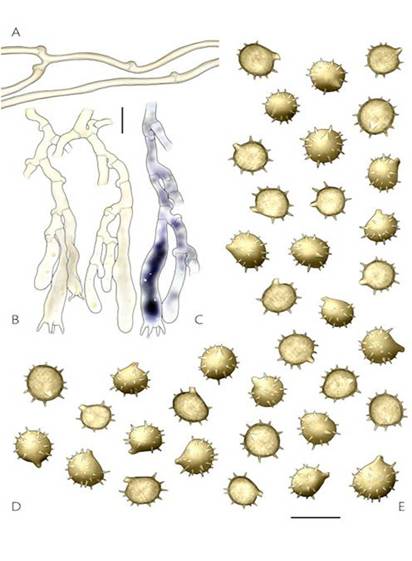
drawing: E. Martini